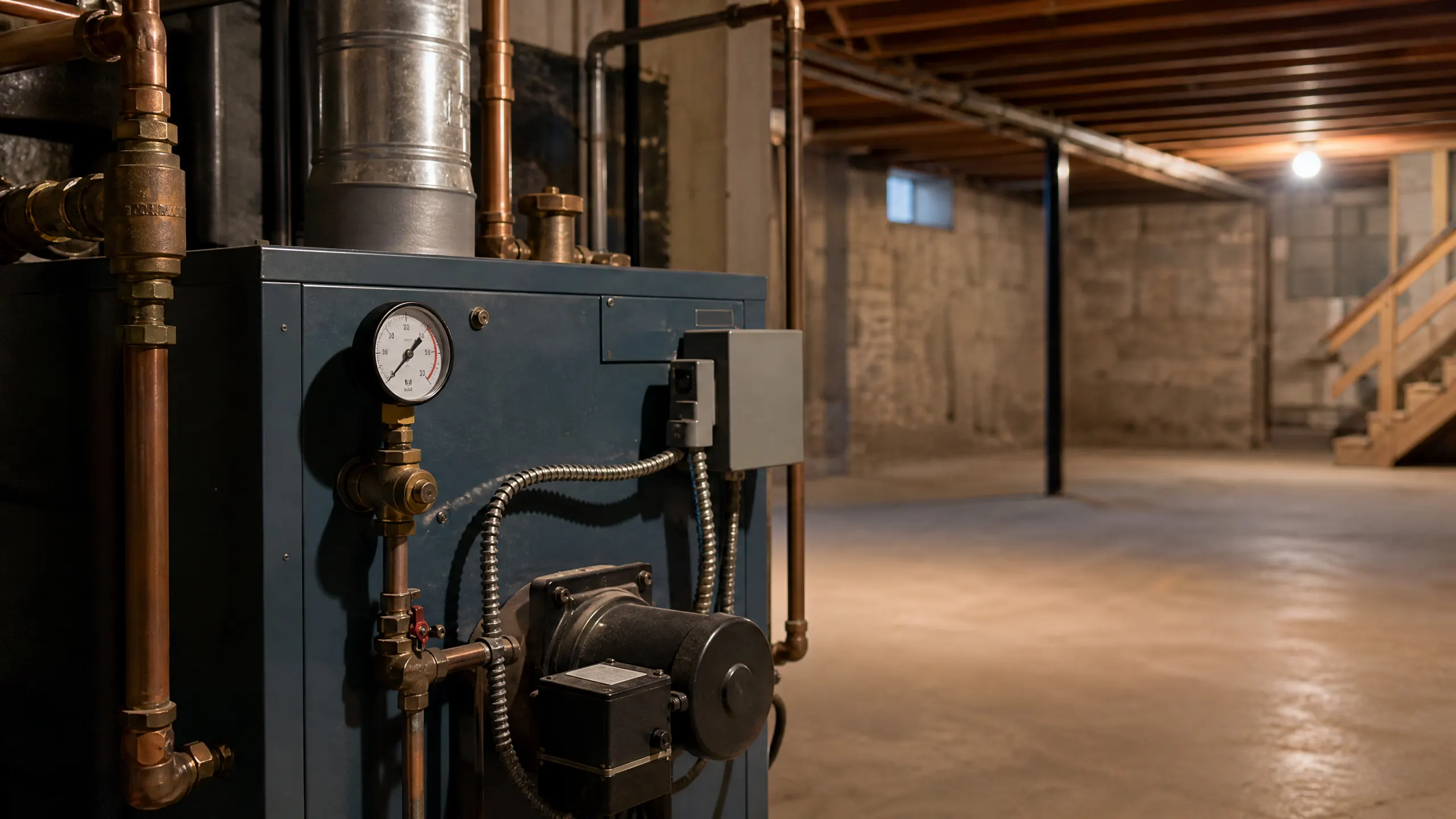



A blue steel boiler with copper pipes and a pressure gauge mounted in an unfinished basement with stone walls and wooden stairs.

Boiler Repair in Warwick, RI

Tell us about the job

Takes about a minute. No obligation.

RepairBoilerKent County, RI
Step 1 of 2

What ZIP code is the job in?

Half the homes in Kent County were built in 1967 or earlier. If your boiler came with a house that age, it's not the original unit, but it may still be older than you'd like, especially if nobody's touched it since the last owner. Boilers can run a long time, but every part in one wears, and a repair on an old unit is sometimes just a down payment on the next repair. Before you spend money fixing what's wrong now, it's worth asking a contractor how much life is actually left in it.

A leak that starts as a drip gets worse under pressure the boiler keeps making.

Shut it down and get someone out before a small puddle turns into a cracked block.

Warwick boilers start their eight-month run in October, and that's when a weak part gives out

Heat runs October through May
Winter nights average 23°F
50 winter storms from 2015 to 2024

Most boiler calls in Warwick are ordinary. A igniter fails, a circulator pump seizes, a pressure valve sticks. Nothing about this city's water or air is hard on a boiler. Natural gas ran $21.08 per million Btu in Rhode Island in 2024, so every cycle costs something, and a unit that short cycles or runs longer than it should is worth a look for that reason alone. The fix is usually the fix you'd expect, not something this house or this county made worse.

Find out what's left in it before you pay to fix it

A repair quote is a good time to ask a contractor how much life your boiler has left. If it's old enough to be a second or third owner, that answer matters more than the repair itself.

Find a contractor

Banging and kettling from the heat exchanger

A boiler that bangs or makes a kettle-like rumble has scale building up on the heat exchanger. Water trapped under that scale flashes to steam and that's the noise you're hearing. It won't fix itself, and left alone it stresses the exchanger until it cracks.
No heat reaching some rooms, or none at all

If some radiators or zones stay cold while others work fine, check a zone valve or a circulator pump serving that loop before you assume the boiler itself is the problem. If nothing in the house is getting heat, that points to the boiler, not the distribution, and it's worth a call the same day since a house with no backup heat source can get cold fast.

A thermocouple or igniter wears out after enough cycles and stops lighting the burner reliably. A circulator pump seizes when its bearing dries out or the motor winding finally gives, and once that happens water stops moving through the system even if the burner lights fine. A pressure relief valve can stick or start weeping after years of use, and once it won't hold pressure the whole system starts cycling wrong. Scale builds up inside the heat exchanger over the years no matter where the boiler sits, and that buildup is what causes most of the banging and rumbling people hear. None of this happens overnight. A boiler on its way out usually gives some warning first, a noise, a short cycle, a room that stays cold, before it quits for good.

A diagnostic call starts with the contractor asking what you've noticed, since a noise, a smell, or a cold room points them somewhere specific before they open anything up. They'll check system pressure and look at the water level, because a boiler running low won't heat right no matter what else is working. They'll watch a full cycle if they can, from ignition through shutoff, listening for the delay or the rumble you described and watching whether the flame holds steady. If the trouble's in one zone, they'll test the circulator pump and zone valve for that loop before they touch the boiler itself. Most of this is done with the boiler running, not torn apart, because a problem that only shows up under load won't show up on a cold unit.