Electricity here runs 28.65 cents per kilowatthour
Rhode Island's electric rates are among the higher ones in the country. A mini split draws power every time it cycles on, so that rate applies to every hour it runs.
Takes about a minute. No obligation.
Rhode Island's electric rates are among the higher ones in the country. A mini split draws power every time it cycles on, so that rate applies to every hour it runs.
At this rate, a unit that holds its SEER2 rating under real conditions costs less to run than one that does not. The difference shows up on the electric bill, not on the invoice from install day.
NOAA nClimDiv, 1991–2020 normals
Westerly only needs cooling in July and August, with afternoon highs around 79°F.
A mini split here isn't running hard all summer, so a dependable mid-range unit is enough to do the job.



Cooling in Westerly runs from July through August, so June is the month to get a mini split installed. Wait until the first hot week and you're competing with every other homeowner who had the same idea, on a schedule the contractor sets, not you. Doing it in June means the unit is tested and running before it has to work. A breakdown in the middle of August means waiting on a crew that's already booked solid, with every other system in town failing at the same time for the same reason.
Washington County homes split about evenly between built before 1977 and after. A mini split sized for this climate and installed to spec works in either one. There's no reason to size up or pay for a higher tier than what the job calls for.
Find a contractorTwo months of real work a year, and the load during those months is moderate. That's not much wear on a compressor rated to run for years. Pick a unit built to last through that cycle and skip paying for a capacity or efficiency tier this job doesn't call for.
If a central system is being replaced, the indoor coil, the outdoor condenser and the line set all get disconnected and hauled off. Window units just get pulled out of the window. Either way, removal is part of the job, not something left for the homeowner to deal with after.
Whatever is running through the old system has to be recovered into a tank before any line gets cut. That's a licensed step, not an extra one, and it's why this isn't a job for taking the old unit out yourself the week before.
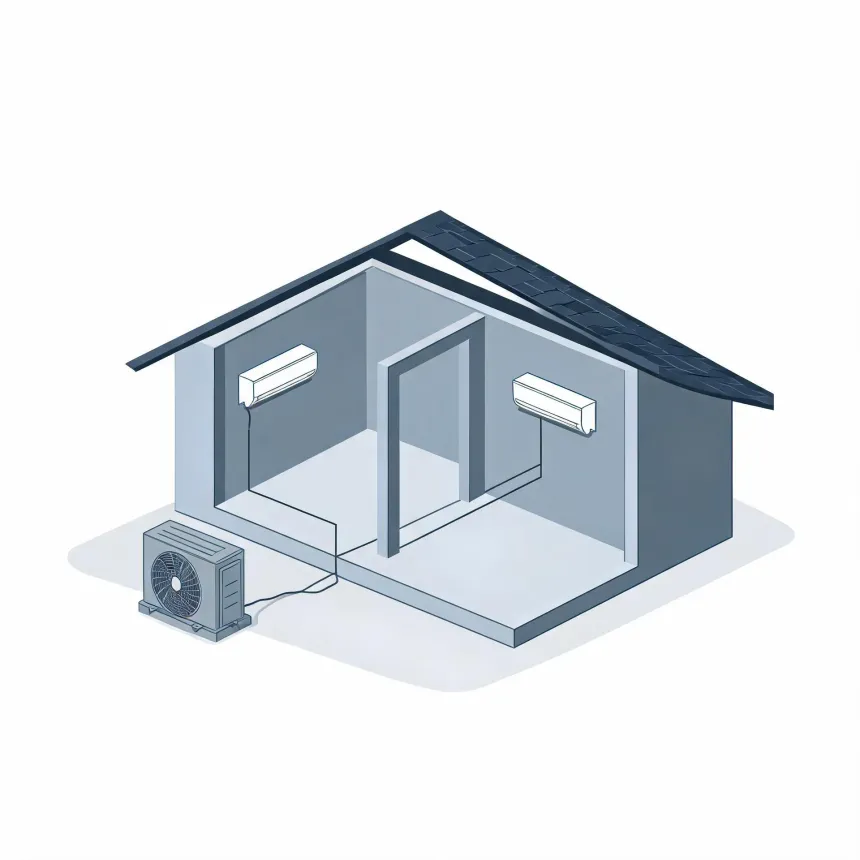
What drives the cost of a mini split install is mostly the line set and where it has to go. Running refrigerant line through a finished wall takes longer than running it through an open stud bay, and if the line has to cross a floor or go up through a soffit, that adds time without adding anything you can see once the cover plate is on. The outdoor unit needs a pad or wall bracket set level and clear of where snow piles up or water drains off the roof, and getting that spot right the first time costs less than moving it later. Electrical work factors in too. Running a dedicated circuit from the panel is a different job depending on how far the panel sits from the indoor head, and whether the panel has room for another breaker at all. Add a second indoor head and the job isn't just bigger, it's a second line set run back to the same outdoor unit, with its own path to plan through the wall or attic.
Install day starts with the walkthrough, confirming where the line set runs and where the indoor head and outdoor unit actually go, because once a hole is cut through the wall that's the path it takes. The indoor head gets mounted first, on a bracket set level so condensate drains the way it's supposed to. The wall penetration comes next, a single hole for the line set, the condensate drain and the power wire, all sealed once everything's run through. Outside, the condenser goes on its pad or bracket, the lines get connected, and the system gets evacuated to pull moisture and air out of the line set before any refrigerant moves through it. Skipping that step is what leads to a system that runs weak or trips out within the first year. Once it's charged, the tech checks static readings and airflow at the head before calling it done, not just whether cold air comes out.