A single-story house with light siding, dark shutters and a gray shingled roof, seen across a mown lawn from a low angle with blurred grass and shrubs in the foreground and large deciduous trees behind.

Mini Split Installation in Newport, RI

Tell us about the job

Takes about a minute. No obligation.

New system or replacementMini-splitNewport County, RI
Step 1 of 2

What ZIP code is the job in?

Electricity here runs 28.65 cents per kilowatthour

Rhode Island power costs more than it does in most states. A mini split that holds its efficiency rating pays you back on every bill it runs through, and at this rate the gap between a good unit and a weak one shows up fast.

Efficiency matters more than the install price tag

When you're comparing systems for your home, the number on the spec sheet is worth as much as what you pay the installer. A cheaper unit that runs harder to do the same job costs you the difference back at this rate, month after month.

8 months
October through May, your system heats
2 months
July through August, it cools
26°F
the average winter night it heats against
79°F
the average summer afternoon it cools against
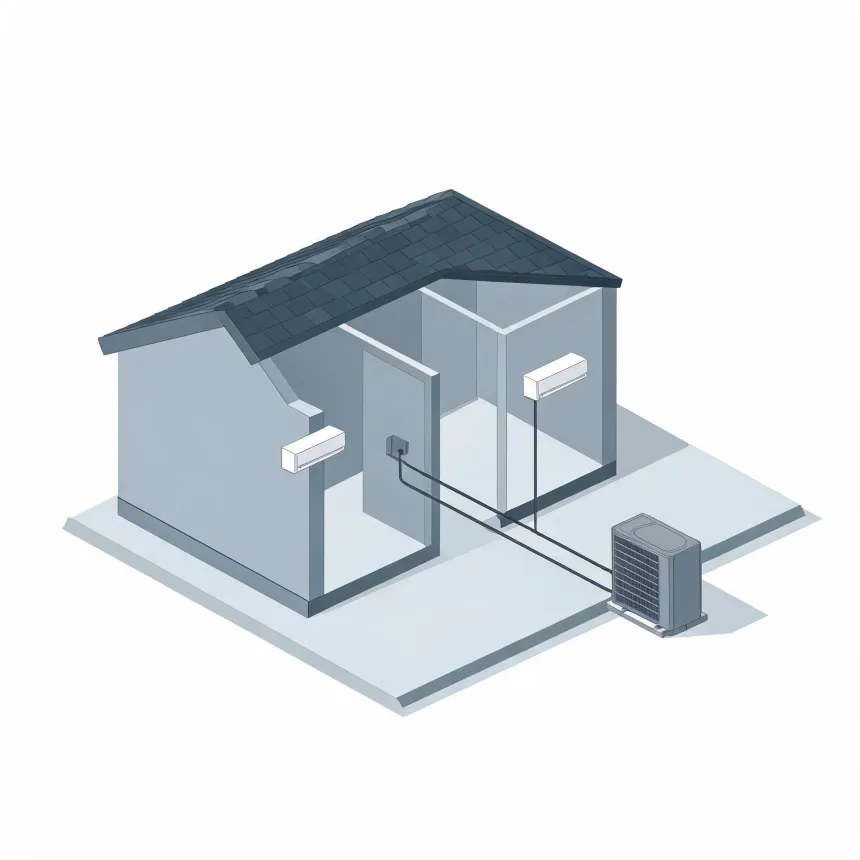
Isometric illustration of a cutaway gray house with a dark shingled roof, showing two wall-mounted indoor air handlers connected by line sets to an outdoor condenser unit on a pad outside.
Your system heats October through May and cools July through August.

NOAA nClimDiv, 1991–2020 normals

The efficiency rating on a mini split only holds up if the size matches the room it's heating and cooling.

An oversized or undersized unit burns through the gap between its rating and what it actually delivers.

Half these homes were built by 1963. A mini split has to fit the one you've got

Half the homes here were built by 1963
Cooling runs July through August
Summer afternoons average 79°F
Two months a year, start nowCooling runs July through August here, so June is the month to have it in and running.

Newport County is in climate zone 5A. It's a cool zone, so heating carries more of the load here than cooling does. A mini split installed here still counts as a split system under federal rules. It has to clear 14.3 SEER2 for cooling and 7.5 HSPF2 for heating, the same minimums as any other split system. There's no separate, lower bar for a ductless unit. A system that meets those numbers qualifies for the federal tax credit.

Here, a mini split usually joins an oil system, not replaces it

Most homes in Newport County heat with fuel oil, not electricity. A mini split doesn't replace that furnace or boiler, it adds heat pump heating and cooling to specific rooms while the oil system stays as backup for the coldest days. That's the common setup here, and it's worth asking any installer how they'd want to zone your place.

Find a contractor
A man in a dark cap, gray long-sleeve shirt and brown work pants climbs porch steps toward a navy front door, carrying a canvas tool tote with tools in its pockets, beside a potted evergreen shrub in a blue planter.
A white mini-split air conditioner outdoor condenser unit mounted on metal brackets against a beige stucco exterior wall, with a blue sky and scattered clouds in the background.

A light enough job, most of the year

Cooling only runs two months here, July and August, with afternoon highs averaging 79. That's a light load for a mini split to carry year after year. Heating stretches longer, but most homes here lean on an oil furnace or boiler for that, with the mini split covering specific rooms. Less run time means less wear on the compressor. A unit here is more likely to fail from age, a bad install, or sitting unused than from being worked hard. A mini split with low hours on it is usually worth repairing rather than replacing, even after a decade or more.

A load calculation, not a tape measure

Sizing a mini split means working out how much heat a room gains in summer and loses in winter. Square footage is part of that, but so are the windows, how many walls face outside, and what sits above and below the room. Rooms that look the same size on paper can call for different size units once all that is counted. An installer who quotes a size straight off square footage is guessing.

Oversized is its own failure mode

A unit too big for the room blasts it to temperature and shuts off, then kicks back on soon after. That cycling is what wears out a compressor early, and it leaves the room swinging hot and cold instead of holding steady. A unit sized right runs longer at a lower output, which is easier on the equipment and steadier on the room. Bigger isn't a margin of safety, it's the thing that breaks the system down early.

Ask how many indoor heads the installer is proposing and why that number, not just the brand of outdoor unit. A single outdoor condenser can run multiple indoor heads, and the right count depends on how many rooms need separate control, not how many rooms exist. Ask what happens to the line set and where it runs, since that's often what decides how clean or messy the outside of the house ends up looking. Ask about the warranty on the compressor versus the warranty on labor, because those are usually different lengths and only one of them is void if the install was done wrong. And ask what sound level the indoor head runs at on low versus high, since that's the part you'll actually live with once the quiet of the sales pitch is over.

Install day starts outside, not in. The outdoor unit needs a spot with clear airflow on all sides and a solid, level pad to sit on, so the crew sorts that placement before anything gets mounted. Inside, each indoor head gets hung high on a wall, and the crew runs a line set from it back to the outdoor unit through a small hole drilled in the wall, usually hidden behind the unit itself. That line set carries refrigerant, a drain for condensation, and the electrical wiring, all bundled together and routed as directly as the layout allows. Once everything is connected, the lines get pressure tested to check for leaks before any refrigerant goes in, then the system gets charged and run through both heating and cooling to confirm each head is doing what it should. A clean install leaves you with a thin line hidden along the wall or siding outside and a quiet head inside that you'll forget is even running.