A white picket fence runs along a grass lawn in front of a row of similar gabled houses with siding, beneath overhanging leafy tree branches.

Mini Split Installation in Bristol, RI

Tell us about the job

Takes about a minute. No obligation.

New system or replacementMini-splitBristol County, RI
Step 1 of 2

What ZIP code is the job in?

Electricity here runs 28.65 cents per kilowatthour

Rhode Island power costs more than it does in most states. A mini split that moves heat instead of making it will use less of those expensive kilowatt-hours than a system that burns resistance heat or runs an old inefficient compressor.

Efficiency rating matters more on this bill

A high-efficiency mini split costs more to install than a low one, but at this electric rate the gap between a good unit and an average one shows up every single month. Worth asking what SEER2 and HSPF2 rating each option carries before deciding.

8 months
October through May, your system heats
2 months
July through August, it cools
25°F
the average winter night it heats against
80°F
the average summer afternoon it cools against
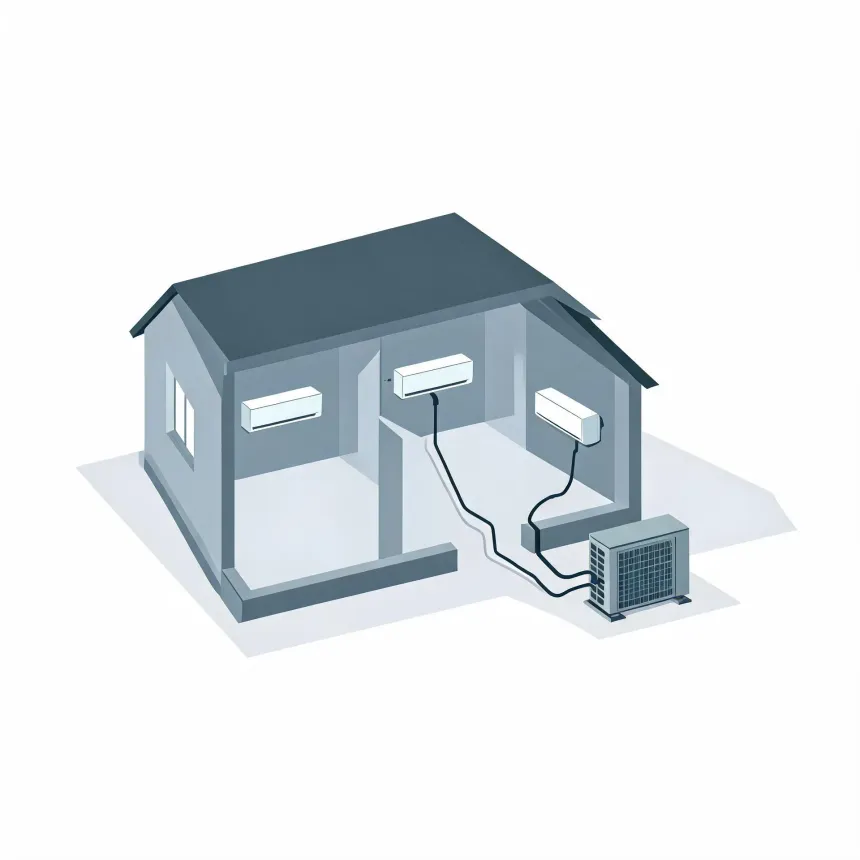
Isometric illustration of a cutaway single-story house with three wall-mounted indoor air conditioning units connected by lines to an outdoor condenser unit on the ground outside.
Your system heats October through May and cools July through August.

NOAA nClimDiv, 1991–2020 normals

Cooling in Bristol County runs about two months a year, July and August.

A mini split here spends most of its life heating, not cooling, so pick it for that job first.

Half the homes here were built by 1957. A mini split has to work with the walls and rooms it's going into, not around them.

Half the homes here were built by 1957
Cooling runs July through August
Summer afternoons average 80°F

Cooling in Bristol County starts in July. If you're installing before then, June is the month to get it done. A contractor working in June isn't racing a heat wave, and if the install turns up something in the wall that needs attention, there's time to deal with it right. Wait until July and you're asking for the same work during the two months the system actually has to perform. Lining it up before the season starts means the unit is tested and running on the first hot day, not the day after you called.

Efficiency pays here

Power costs more here, so an efficient system pays you back on every bill.

Find a contractor
A man in a navy T-shirt, tan work pants and cap, seen from behind, carries a worn canvas tool bag up wooden porch steps toward a dark blue front door.
A white outdoor air conditioner condenser unit mounted on metal wall brackets against gray horizontal siding, with a blue sky and white clouds behind it.

The old system doesn't retire, it just works less

Whatever is heating and cooling this house now does not get hauled off the day the mini split goes in. In a lot of installs it keeps running, just less, because the mini split takes the easy hours and the old system handles the rest or backs it up entirely. If that old equipment is already worn, running it less can stretch what's left of it. If it's near the end anyway, this is often the point where a homeowner decides whether to replace it now or let it ride until it fails. Either way, the old system's duty cycle changes the day the new one starts working, and that's worth planning for rather than finding out.

Sizing is a room by room calculation

A mini split is sized by working out how much heat each room loses in winter and gains in summer, based on the windows, the walls facing out, and the room's dimensions. That calculation points to a certain output for each indoor head. Skip it and guess from square footage alone, and the unit that gets installed is sized for nothing in particular.

Oversized runs worse than undersized

A unit sized too big for the room reaches the set temperature fast, shuts off, then starts again a few minutes later. It never runs long enough to pull moisture out of the air, so the room feels cool but damp. A properly sized unit runs longer at a lower output, which is what actually keeps the temperature steady and the air dry.

Comparing mini splits usually comes down to brand name and price, but the questions that matter are about the install, not the box on the wall. Ask how many indoor heads the outdoor unit is rated to run, and whether adding a future head means replacing the outdoor unit or just adding to it. Ask about the line set length and whether the walls between indoor and outdoor units allow a clean run, since a longer or more bent line set affects how the system performs. Ask what happens to the old thermostat and controls, and whether the new system runs on its own app or wall unit instead. A multi-zone system lets each room run at a different temperature, but every zone pulls from the same outdoor unit, so ask what happens to the other rooms when one zone calls for a lot of heat or cooling at once.

Installation starts outside, with the outdoor condenser. It needs a spot with clearance on all sides for airflow, mounted on a pad or brackets so it sits level and off the ground. Then comes the line set, the pair of copper lines that carry refrigerant between the outdoor unit and each indoor head. A hole gets drilled through the wall, just big enough for the lines, the wiring and the condensate drain to pass through together. Once the indoor head is mounted and the lines are connected, the system gets evacuated with a vacuum pump to pull out all the air and moisture before the refrigerant is released into the lines. Any air or moisture left behind causes problems later, so this step gets done properly or the whole system runs poorly from day one. After that it's a matter of powering it up, checking the temperature split between the air going in and the air coming out, and confirming each zone responds the way it should.